
by David Birch | Nov 29, 2024 | Recent Articles
We are in the final throes of autumn as I sit down to write this. December, and winter is about to begin. Before we know it, we will be entering a new
year. Although the darker days are upon us, at least the autumnal foliage on the trees has once again given us a magnificent display.
Just to explain the process that leads us to this annual phenomenon, a green leaf is green because of the presence of a pigment know as
chlorophyll, which is inside a special part of a cell in the leaf structure. When it is abundant in the leaf’s cells, as it is during the growing season, the
chlorophyll’s green colour dominates and masks out the colours of any other pigments that may be present in the leaf. Thus, the leaves of summer are
characteristically green. Chlorophyll has a vital function: it captures solar rays and uses the resulting energy in the manufacture of the plant’s food –
simple sugars which are produced from water and carbon dioxide. These sugars are the basis of the plant’s nourishment – the sole source of the carbohydrates needed for growth and development. In their food-manufacturing process, the chlorophylls break down, and are being continually used
up. During the growing season, however, the plant replenishes the chlorophyll so that the supply remains high and the leaves stay green.
In late summer, as daylight hours shorten and temperatures cool, the veins that carry fluids into and out of the leaf are gradually closed off as a layer of special cork cells forms at the base of each leaf. As this cork layer develops, water and mineral intake into the leaf is reduced, slowly at first, and then more rapidly. During this time, the chlorophyll begins to decrease. Often, the veins are still green after the tissues between them have almost completely changed colour.
While all this has been going on and the trees appear to be in their death throes, hazel trees are starting their life again by producing catkins. The male
flowers are long yellow catkins, known as ‘lamb’s tails’. They first appear around late October to early November, and are short and green. Between
February and April they open up to release their pollen. The female flowers, which grow on the same tree, are small, red and bud-like in appearance. It is the female flowers which later develop into the hazel or cob nuts. Bees find it difficult to collect hazel pollen and can only gather it in small loads. This is because the wind-pollinated hazel has pollen that is not sticky and actually repels one grain against another. Also hazel is monoecious, meaning that both male and female flowers are found on the same tree, although hazel flowers must be pollinated by pollen from other hazel trees.
During the long December nights, tawny owls may be heard staking out territory, with both the male and the female birds creating the classic owl ‘tu-wit tu-who’. Tawny owls pair off from the age of one year, and stay together in a usually monogamous relationship for life. An established pair’s territory is defended year-round and maintained with little, if any, boundarychange from year to year. The pair sit in cover on a branch close to a tree trunk during the day, and usually roost separately from July to October. Roosting owls may be discovered and mobbed by small birds during the day, but they normally
ignore the disturbance.
During the daytime, robins are one of the few birds that can be heard singing during winter, as both the males and females maintain territories for feeding during this period, which may be their breeding territories later. Around Christmas time, robins begin exploring other robins’ territories looking for a mate. They then pair up by mid-January and females stop singing. It’s also mating time for the fox, so listen out for their blood-curdling screams at night. If you don’t hear them, you are almost certain to smell them! At this time of year they advertise their presence to each other by scent marking their paths with their urine.
All of our amphibian and reptile species (i.e. common and natterjack toads, slow-worm, common and sand lizards, common, smooth and great crested newts, adder, smooth and grass snakes) are hidden away underground until spring, and sometimes together in mixed groups. Only the common frog chooses a different method by hiding at the bottom of a pond.
So now, as the season of the Holly and the Ivy is upon us, and as we gather mistletoe and scented pine to decorate our houses, it only remains for me to wish you all a peaceful Christmas and a very Happy New Year …
’til next year!
Geoff Pinn

by David Birch | Nov 29, 2024 | Recent Articles
Dear Community
You may recall the Informal Public Consultation held by governors in May 2024, regarding the relocation of Tipton St John Primary School. Governors were grateful for the responses and listened to people’s concerns. As a result, governors wrote to Devon County Council seeking further clarity on the Council’s commitment to rebuild the school within Tipton St John village. Last week we received a response from DCC stating that their preference continues to be for ‘the school to remain in Tipton if an affordable / deliverable solution can be found in a timely manner’.
During the summer, DCC were in communication with the Department for Education to ascertain the level of diligence required for each site in Tipton before the DfE would consider commencing their feasibility studies. The significant costs to complete this work will be approx £600,000 and DCC has no funding sources to undertake this work. However, East Devon District Council has recently invited bids against their Community Infrastructure Fund and DCC has submitted a bid for £600,000 to undertake the required works on the Tipton sites.
A timeline for a decision from EDDC on whether they will accept this bid has not yet been confirmed, but we hope to have some news after Christmas.
This decision will be critical for Governors in deciding their next steps. If these investigative works cannot be funded by DCC, then the governors will have no choice but to proceed with a formal con-sultation on a site outside of the village.
The governors are committed to keeping the school within Tipton. However this is balanced with prioritising the safety of children and staff and the continual assessment of the ongoing risk of flood and poor condition of the lower site. Governors also need to weigh up the time it could take to secure funding and complete the diligence, with no guarantee at the end that a deliverable site in Tipton will be accepted by the DfE.
The governors will keep parents and the wider community updated on developments.
Kind regards,
Amanda Fulford
Executive Headteacher

by David Birch | Nov 29, 2024 | Recent Articles
TIPPS News
Thank you to all those of you who came to see our autumn production ‘Miranda’. Congratulations must go to Janet Farrow, the director and all the cast for a superb production. Some of you may have seen the photos in the Sidmouth Herald along with a great review from Tricia Barclay our NODA Representative.

Peter Blackmore, the author of the play, was apparently inspired to write it, after hearing of the Cornish legend of the Mermaid of Zennor. There is chair in the church there, dating from the Middle Ages, that has a mermaid carved on it. If you are interested in having a look just type, Mermaid Chair Zennor, into your search engine youcan read all about it.
We are not resting on our laurels, we now have got the cast together for our for pantomime ‘Aladdin’ which is, as usual, in February 2025 and we go straight into rehearsals on 14th November, full details will be in the next issue of the Tipton Times.
Wishing you all a Merry Christmas from all at TIPPS.
Yvonne Kellett
The Early Days – A Previous Production of Miranda
The recent TIPPS brilliant production of Miranda by Peter Blackmore is not the first for Tipton St John as it was one of the five plays put on in the early days of the Tipton Players formed in 1947. It first appeared in 1950, only two years after it was written.
At that time the Hall, although in the same place, was very different and then called the Church Institute. For the first productions a stage was built at what is now the kitchen end using beer and milk crates covered with trestle table tops. This temporary stage was later erected at the end where the main entrance foyer is now. The curtain with fixtures and a facia was made by Coles of Ottery St Mary at a cost of £13.10s.0d but was only in position for the plays and taken down to be stored by a Mrs Sage.
The first permanent stage was not built until 1961 . Mr Jack Pease, who was for many years the leading force for drama production in the village, complained for some time about the difficulty of erecting the stage and asked for a permanent one to be built. The Institute agreed as long as it was done at no cost to them! Jack agreed to advance the money, oversee the building and when it was complete it would be the property of the Institute. Unsurprisingly he was given the go ahead. This cost £68.4s.6d, that is the equivalent of approx £1350 today. A generous gift.
The stage was not erected in its present position until 1979.
What would the 1950 cast have made of our present facilities I wonder? Now we have a stage which is the envy of many local societies, although the seating capacity for audience with a good view of the stage has little altered.
Ann Knight
The 1952 production of The Ghost Train
by David Birch | Sep 29, 2024 | Recent Articles
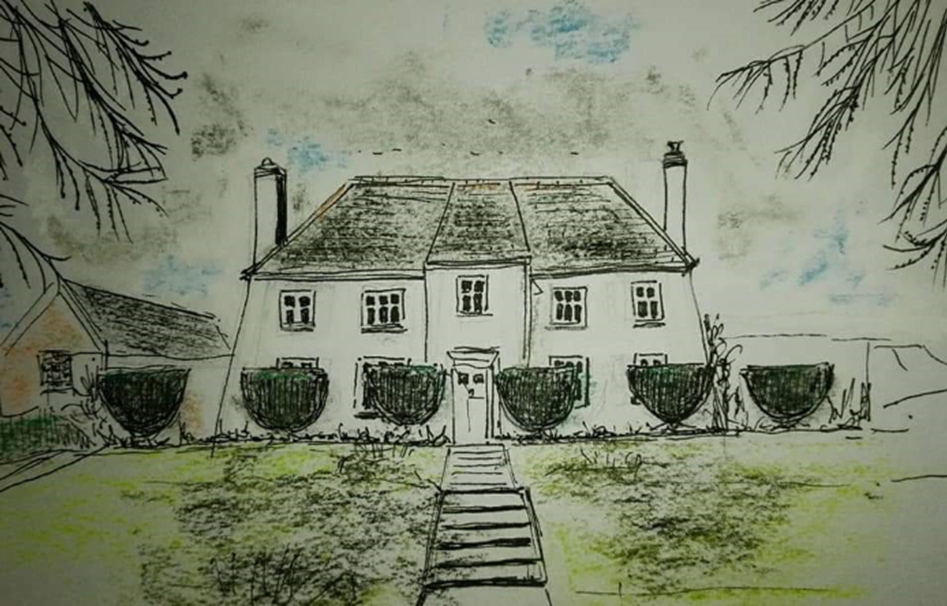
 Buried under the large porch flagstones at Venn Ottery church are the remains of William Taylor and his family. For years I have walked to and fro over these stones with little knowledge of the family listed on the inscription below. William Taylor was born in Sidbury but came to live at Elliott’s Farm in Venn Ottery, around 1790. At this time Elliott’s was described as arespectable, roomy thatched dwelling house, standing on a gentle elevation, with a succession of terraces at the front, walled gardens, large farmyard with stables, barns, linhays and 153 acres.
William married a local girl and started his family and he farmed at Elliott’s for around 40 years until his death in 1832. His first sons were twins who were born in 1809; John (Read) and Richard. When their father died the brothers took over the estate of Elliott’s Farm including Venn Ottery Common, from their father. They also seem to have been running Elwill Farm, in Tipton, which was then the dairy farm belonging to Elliott’s. They later acquired Brownings, a small farm, described as a gentlemen’s residence in Southerton and Heathlands, a smart property in Higher Metcombe. Together the young men owned a large acreage of land in and around Tipton. On the 1851 census both John and Richard are registered at Elliott’s but John is named as the farmer and Richard is named as a ‘landed proprietor’ which was a term not familiar to me, but means that he also hadownership of the farm and land even though he wasn’t farming there himself.
 Their farm was stocked with mostly sheep, (wool was still a popular commodity at this time),breeding and fattening pigs, and riding and harness horses, including a cart horse. Also, cows and oxen, not just for the meat and milk but also to use at the plough. Two oxen could be yoked together and worked at the harrow or the plough, covering an acre a day, and were cheap to feed. The plough boy wasemployed to encourage them along with a song or a chant, Charles Channon was the 13-year-old plough boy working and boarding at Elliott’s, in 1850.
They sold timbers such as oak, ash, elm and fir and grew maiden trees, as well as growing arable crops – corn, oats, barley and meadow hay. There were also areas of land with coppiced willow, ash and hazel, used for building, fencing, and hurdles. Some areas of old coppice woodland can still be seen in Venn Ottery although now overgrown. There was a sawpit behind the farm, over which timber was positioned to be sawn with a long two-handled saw, by two people. One above the timber and one below in the pit, the top sawyer stood above and the bottom sawyer stood below in the dirt and dust. Bark was stripped from the trunks and stems of the oak, hazel and ash, which was then bagged and sold to the leather tanners to be used in the process to tan hides.
The Taylors produced their own cider, which was the traditional drink of Devon and it generated a regular source of revenue. Large apple orchard fields surrounded the house at Elliott’s, Elwill and Browning’s. Although the double screw cider press and oak apple press are now gone, the Apple Mill is still in situ today at Elliott’s, which would have been used by the Taylors to make their popular cider. Cider was also part of the farmer’s payment to his labourers, I’m not sure whether this inhibited orencouraged their labouring capacity! The family cider was then sold locally in hogshead barrels – this related to the measurement of the volume of cider within the barrels. The Taylors became known for their quality cider.
 There are numerous interesting newspaper reports relating to the sales of their different stock over the years other than cider. There were packs of wool, nitches of reeds, planks of wood, maiden trees, bushels of corn, sacks of potatoes and, at one farm sale, even a pile of wood ash and eight dung heaps are listed – so there was even money in muck.
During the mid-1800s John farmed the land at Elliott’s whilst Richard oversaw the workings of the other estates and lived later at Heathlands. Their younger brother George moved to Ottery where he owned and ran the Tanners Yard, along with his sister Mary. This building would have stood opposite the mill/factory, on the turning for Mill Croft. Along with the yard was a cottage, drying loft, bark store and eight acres along with orchards. It is mentioned in the report of the great Ottery fire of 1866 where the flames “attacked Mr Taylors Tan-yard and destroyed all that was consumable”, water hosed from the river saved the back of the tan yard. They must have rebuilt the business as it is offered for sale in 1869. The building itself was knocked down in the 1960s.
I imagine that the tan yard would have used hides that came from their animals and also the bark from their trees which was used in the tanning process, so the yard was very much part of the family business. Mary, the sister, who lived and worked at the tan yard was also registered to sell alcohol. Maybe she sold some of the family cider – let’s hope it was to takeaway, though, as I’m not sure I’d want to stop and drink alongside the Tanners Yard. It must have been an interesting aroma.
The Taylors seem to have been hard-working land owners, who from my research, out of William’s five children, only Richard married. The others remained single, and one other brother, James, died from a riding accident in his twenties. As the siblings aged it appears there were no children to inherit the family estates. When John (Reed) Taylor died aged sixty he was described as “kind and liberal to the poor and his death will long and deeply be remembered by them”. He has his own grave in Venn Ottery on the north side of the church, a grand low stone tomb, surrounded by imposing metal railings. Richard died in 1873, after a long illness at Heathlands, Metcombe, the last Taylor sibling, leaving his estate to his wife Fanny Taylor. On the last census I find her occupation is described as a gentlewoman, so she was obviously of a high social status. After this, the remaining estates were sold and I lose track of where Fanny ended up. It’s always frustrating when you can’t continue the family line Maybe someone knows more than me and knows where Fanny went.
 At least now when I walk into church, I feel I know a little more about the Taylors and the part they played during their time in Tipton, Metcombe , Venn Ottery and Ottery St Mary.… and even a littlemore about farming practices of over two hundred years ago in our villages. And don’t forget little Charlie Channon, the plough boy, singing to his oxen.
Judith Taylor
by David Birch | Sep 29, 2024 | Recent Articles
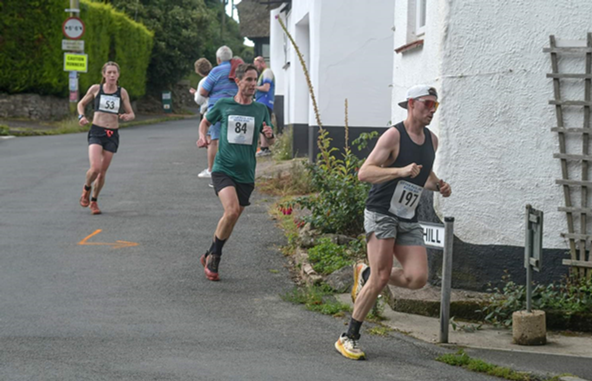
Thank you to everyone  who supported the Otter Rail and River Run in 2024. The event this year kicked off a weekend of fun-filled activities in the village. I was inundated with helpers, some new and others who have marshalled the same corner for years. The conditions were great, barring a particularly boggy section of the green lane and runners were again in good spirits. The Fun Run had a massive turn out – luckily I had bought extra jelly snakes just in case.
The first three runners across the line were Colin Densham (38.41), Jamie Howard (39.2) and Adam Rutter (42.07). Ellie Dominey (42.37) wasn’t far behind, followed by Sofia Lenzi (43.56) and Hannah Brown (46.24). Last year Sofia had smashed the fun run so it was so great to see her excelling over the longer distance. First local man was Mike Leworthy and first local woman Catherine Hilton. The age category winners were Sofia Lenzi (WS), Colin Densham (MS), Ellie Dominey (WS35), Jamie Howard (MV40), Hannah Brown (WV45), Graham Hill (MV50), Julie Payne (WV55), Andrew Johnson (MV60), Eleanor Wood (WV65) and David King (MV70).
The event was sponsored again by Michelmores, East Devon Law and Otter Brewery. The beautiful trophies were made by Kensdale Carpentry and Tony Rule. Prizes were donated or supplied by Pinnacle Icing and Devon Heaven Food Hampers. We are so grateful for the support from these local businesses.
Thanks to everyone’s efforts we raised around £4000 for the Tipton St John Playing Field Association and other local charities.
A final, enormous thank you goes to all the volunteers who supported the Otter Rail and River Run – it takes a village to make this event so special. Big thanks especially to Mo and Ken Mylne and Sam and Mark Rigden. I have really enjoyed my time organising this event and look forward to helping again next year (maybe you’ll see me marshalling or selling teas). We have had some volunteers offering to take on the organisation next year for which I am so very grateful.
If you want to get involved just pop an email to otterrailriverrun@gmail.com.
Jemma Wiltshire
by David Birch | Sep 29, 2024 | Recent Articles
With the current uncertainty about the future of our school I thought some details of past difficulties encountered may be of interest.
In 1842 land was given to build a school on the upper site for the purpose of educating the children of the district in the ‘principles of the Established Church’. The school opened in 1843 in a two-storey building with the infants upstairs but in 1890 the upper floor and staircase were removed, the building enlarged and an infant classroom built on at the back. The usual age for entry was three and numbers of children were between sixty and eighty-four. Imagine!
At the end of 1945 correspondence took place with the County and Diocesan Authorities regarding the future of the school. At first improvements to the building were intended but later it was intimated that that it would not be possible to meet the new regulations required by the Ministry and as the cost of a new school would be over £8,000 (!) it was intended to close the school and transfer the children to Ottery. An announcement to this effect was made on a public holiday with a request to respond in three days but fortunately the School Managers (as the Governors were known then) protested strongly against the rush. They pointed out that Tipton was a Voluntary Church School not a County one and an inaccurate figure of the number of pupils was being used. Some of the Ministry of Education Development plans of 1946 laid down that village schools should be considered individually on their merits with special reference to parents wishes and the extent to which the school contributes to the life of the village community.
It seemed our school had not had a fair deal. After much correspondence, an appeal led by the then Chair of Managers, Major General Dening, was made to the Ministry of Education in London accompanied by a petition signed by seventy-four parents. In 1950 the retention of the school in Tipton was confirmed. In fact, the then permanent Secretary for Education John Maud visited the school and remarked that ‘It was the best of its kind he had seen for some years’
In 1959 a site for new school next to the Church Institute (now Community Hall) was earmarked. Development was slow but assurance given that there was reasonable future for the school as long as numbers kept up. In 1958 the County Director of Education said it was hoped to proceed with the building in about six years!
In 1951 the managers had opted to be classed as an Aided School which gave them more control over management, religious education, appointment and dismissal of teachers as well as a percentage of responsibility for exterior repairs. Also the Managers should provide 25% of the cost of building a new school. I think this was later lowered to 10%.
The percentage was provided by generous donations from individuals, parents, fund raising events and the PTFA. To help meet the obligation a scheme was started by Manager and benefactor, Mrs Marriott which involving eight village organisations agreeing to contribute £7 a year. In the event of the funds not being used for a new school they would be returned. It was called ‘The Tipton St John Building and Endowment Fund with an account opened in July 1953. In January 1972 it stood at £1,477.30.
Still no new school but in 1969 a temporary classroom (with a twenty years expected lifespan I believe) was provided by the Education Authority for the infant class on land next to the Institute. By 1978 school numbers were in the sixties and more accommodation was needed so the Building Fund then standing at £2,500, plus money from a Trust accessed by, Mrs Marriott, was used to provide another classroom, a wooden building manufactured by Devon Lady, a firm in Honiton. It was sited next to the ‘temporary classroom’ with the proviso that if no longer required by the Education Authority it should become the property of the village. Although wooden this building has planning as a permanent building.
In 1990, with numbers having dropped refurbishment of the old building started with the whole school being accommodated on the lower site. The floor was put back in the old building with a staircase enabling two classes to be held in the space. The loos had a make-over too I think. In 1992 school moved back over the road but by 1993 the Mary Marriott room was being used for reception and in 1994 with numbers reaching sixty-five the infant classroom which had been briefly used by the ‘Owlets Playgroup’ was needed for the infants again.
In 2000 a staff room was provided and in 2002 the porch was added on the front of the lower site buildings. More efforts to get a new school built were being made but encountered continual setbacks. The problem of flooding became a major consideration in the 2000’s and the site earmarked in 1959 which has actually been used by the school for over fifty years was no longer considered suitable.
What a fight for survival the school has put up throughout its history. Think what the village might have been like if the school had closed in 1947. How many young families might not have moved in. Nearly eighty years of fighting-keep it up.
WE MUST KEEP OUR 180-YEAR-OLD SCHOOL IN THE VILLAGE.
Ann Knight (Former parent, manager and classroom assistant. Always a supporter)

Recent Comments