by David Birch | Jun 1, 2026 | Recent Articles
Tipton School
I’m continuing to work closely with a multi-disciplinary team of officers at Devon County Council to help secure the future of Tipton School. We’re meeting weekly, and I’m also regularly in touch with the school’s Governors on this really important project. I’m doing everything I can to try to secure the school within the village.
U-turn by Devon County Council sees it abandon cuts to library opening hours
Ottery St Mary Library was one of dozens of libraries across Devon facing significant reductions in opening hours under proposals brought forward by Devon County Council. The Friends of Ottery Library led an excellent campaign to stop the cuts and I was pleased to work with them on this. They presented a petition of more than 1,800 signatures to the Leader of the County Council and held a protest outside Ottery Library. I also formally challenged the proposals through the council’s scrutiny process.
The response to the public consultation on the cuts to the opening hours was overwhelming, with more than 25,000 responses submitted across Devon. It was clear that residents strongly rejected the idea that people would simply travel elsewhere if their local library reduced hours or closed – 93% opposed this. I’m really pleased that the County Council listened and has now dropped the proposed cuts. This is a genuine victory for local communities and campaigners who made it clear how important libraries are.
20mph for Tipton and Wiggaton?
The rollout of 20mph zones across Devon has unfortunately been very slow. However, town and parish councils do have the option to introduce 20mph limits themselves if they are able to cover the costs – which are considerably higher than many people expect because of the legal and traffic order requirements involved. Ottery St Mary is one of only a small number of places where Devon County Council has funded and implemented a 20mph scheme. I’m very supportive of extending 20mph zones more widely across my division, including Tipton and Wiggaton. A preliminary consultation will be carried out by Ottery St Mary Town Council to gauge public opinion.
Tipton – Bowd Road reopening
I’m really pleased that the Tipton-Bowd road has now reopened. I know how difficult the closure has been for residents, businesses and families, with long diversions causing ongoing disruption since Storm Chandra. I pushed for every possible option to be explored, including reopening the road under temporary traffic lights while longer-term stabilisation work continues.
There will likely need to be a short additional road closure to allow the repaired section of road to be resurfaced. I’m hopeful this closure will only be for a day or two, but I don’t yet have confirmed dates.
Footpath 24
This is a well-used and valued footpath and I appreciate how frustrating its closure has been. I’m in contact with the Public Rights of Way team at Devon County Council, who are working with landowners and tenants to put a formal diversion in place. DCC is also liaising with the Environment Agency about options to stabilise the riverbanks. I know this is a priority for the community and I’ll continue to press for this to be resolved as quickly as possible.
Gerway Farm, Sidmouth Road, Ottery – 140 houses refused
I’m very pleased that this application for 140 houses was refused by the EDDC planning committee in May. I spoke at the meeting to object, alongside Cllrs Vicky Johns and Peter Faithfull, as well as five local residents. There was a strong turnout, with around 60 people attending to oppose the application. It was a nail-biting meeting and it took around two and a half hours for the committee to reach its decision. In the end, the application was refused due to its impact on the rural character of the area, the loss of best and most versatile agricultural land – and the fact the site was outside the built-up area of Ottery St Mary.
This was a really significant outcome for the town and reflected the strength of local feeling about the scale and impact of the proposal.
Cllr Jess Bailey 01404 814056 email jessica.bailey@devon.gov.uk

by David Birch | Mar 24, 2026 | Recent Articles
Tipton St John Playing Field will be playing host to runners from around the south-west in July and, possibly, around the world next April.
Two events are in detailed planning stages, the first is the annual Otter Rail and River Run 10km, which will take place on Saturday 11th July 2026, 10.30am start for the Carol Weaver Fun Run and 11am for the 10km. This is an important annual fundraiser for the playing field, requiring more than 50 marshals and helpers on the day to see the runners safely around the course, take entries, serve refreshments, manage car parking, etc. All marshals from previous years should receive a direct email in April, so please check your inboxes or contact me direct at jo.earlam@hotmail.co.uk
The Otter Run began back in 2007 to mark the then 40th anniversary of the playing field. Ten years later, for the 50th anniversary, Women Can, a women-only marathon, was held from the field, celebrating the achievement of the first woman to officially run the Boston Marathon, Kathrine Switzer, at a time when, in the Olympics, the longest women’s race was the 800 metres. Many local people pitched in and made this event a huge success, much enjoyed and remembered fondly by the 400 women who entered from across the globe. Next year’s event will be on Sunday 18th April 2027, the day before Boston when big celebrations will mark the 60th anniversary of Kathrine Switzer’s groundbreaking 26.2 miles. A new organising team is in place, and new course – with the start and finish being from Exmouth, passing through Tipton as the halfway point, and the half marathon will start from the playing field. A long way off and lots to plan and do. Please get in touch if you’d like to know anymore or would like to help. The website is live at www.womencanmarathon.co.uk
Jo Earlam

by David Birch | Mar 24, 2026 | Recent Articles
Recently Tipton has felt rather cut off from the outside world; with roads collapsing, closures, traffic lights and potholes, all restricting normal access in andout of the village. Due to subsidence the Sidmouth road has been completely closed and has caused quite a struggle for many of us trying to get to and from Sidmouth, having to find alternative routes which then take us onto the narrower lanes.
The Sidmouth road was built around 1845. Previous to the B3176 being constructed you could only travel from Tipton to Sidmouth either via Combe and up over the Goyle ridgeway or along to Harpford and up beside Northmostown or probably the most favoured route would have been past Hayne and up Seaway lane, hence the name. From the top of Seaway you could continue onto upper Seaway or bear right and follow a track around the side of the hill at Woods Farm bringing you to Harpford woods and onto the Bowd. Back then you would have been walking these lanes, possibly with a donkey or pony to carry your goods. These lanes would have been muddy, rough and steep in many places and probably impassable in areas for a ca
In 1844 Parliament passed an act to create a new toll road from Sidmouth to Ottery and onto Cullompton. The Turnpike trust borrowed five thousand pounds to build the new road but they spent all the money and more in the first year of constructing the road and had only completed as far as from Sidmouth to Ottery. Purchasing the land, paying surveyors, contractors and legal fees quickly used up the money. The section across the Goyle at Tipton and up around to Woods Farm represented a significant engineering challenge and must have cost a great deal of the monies raised for the road. Large embankments carry the road across the Goyle and support it as it steeply skirts the hill towards Woods farm. Tolls were collected on theSidmouth top road by Greenway Cottage, at the Bowd and at Tip Hill, Ottery.
In 1846, The ‘new road’ as it became known locally, enabled coaches to be able to offer a daily service from Sidmouth out to Ottery, four horses pulling carriages with people travelling and mail to be delivered. Peter Orlando Hutchinson, of Sidmouth wrote of taking the coach in 1855 when he was involved in an accident on the road, one and half miles from Ottery. “the coach was very heavily laden with luggage piled on the roof so much so as to make it top heavy, besides which there was a full complement of passengers. One of the leaders became restive, and set off the horses causing the coach to oscillate to and fro until it tipped onto a cottage garden bank. Some of the passengers jumped or fell from the coach. People began to pick themselves out of the cabbages and turnips to shake the earth from their clothes and to assure themselves that their limbs were safe, then many hearty laughs followed the adventure.”
 The tolls were not sufficient to cover the upkeep and in 1850 the trust had to apply for a grant to make repairs. Things improved for a while with some money being made for the trustees from the tolls taken at the gates but when the train line to Sidmouth was opened in1874, the use of the roads declined and the trust eventually decided to wind up the business, closing with huge debts. The trust however had left the lasting legacy of a much-improved communication between Ottery and Sidmouth for future generations. And so today we now appreciate just how useful this road is and how much we miss it while it’s closed.
Ref: Chris Wakefield ‘One of Ottery’s turnpike roads’, OSM heritage; Peter Orlando Hutchinson diaries; The British Newspaper Archives. Aerial photographs – Wayne Pop
Judith Taylor

by David Birch | Jan 25, 2026 | Recent Articles
And so, it begins again. I do hope 2026 has started well for you. Just when the mud was walkable on, as opposed to in, it looks like the rain has turned it all back to a sloppy mess again. It’s hard to know what is coming next after the big storm in January. Hopefully by the time you read this, winter’s end will be in sight. But with February brings this old saying, “February fill-dyke, be it black or be it white, but if it’s white, it’s the better to like.” Let’s wait and see!
I recently had a conversation regarding Redwings, or rather the lack of sightings of them. The cold winter weather normally brings them in large flocks. A tiny population of Redwings breeds in the UK, but most of our birds come from Iceland and Scandinavia in the winter. Perhaps a dozen pairs of Redwings, and even fewer Fieldfares, stay to breed in northern Britain, but with the onset of climate breakdown that number is falling, and both may soon disappear as British breeding birds. Whether warming winters will eventually mean they stop visiting us altogether, we are unable to know. But for now their presence is very welcome. The Redwing is the UK’s smallest true thrush. Look for the creamy strip above its eye and the orange-red flank patches. They roam across the UK’s countryside, feeding in fields and hedgerows, rarely visiting gardens, except in the coldest weather when snow covers the fields. Redwings are classified in the UK as amber under the Birds of Conservation Concern 5: the Red List for birds (2021). Protected in the UK under the Wildlife and Countryside Act, 1981. Listed as near-threatened on the global IUCN Red List of threatened species.
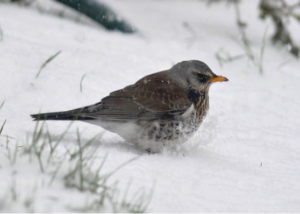 The aforementioned, grey-headed, chestnut-backed Fieldfare is the largest of the thrushes, and visits Britain and Ireland during the winter months. Fieldfares begin arriving on the UK’s eastern coasts from Fennoscandia, western Russia and eastern Europe during early October. Numbers vary each year and are dependent on berry crops closer to their breeding grounds. In years when crops are poor, fieldfares move in large numbers in search of berries elsewhere and it is under these conditions that the largest numbers occur in Britain and Ireland. The Fieldfare has been on the UK Red List since 2009.
There are many other migrant species of bird with us at the moment, but a rare treat, if you get the chance to spot them, are Waxwings. Every three to four years these birds arrive in large numbers, either because of a food shortage, or particularly harsh weather conditions in their native Scandinavia. They normally arrive in the North and East of the UK, but there have been so many sightings this winter that we could be lucky enough to spot them here as they move south westwards. Waxwings have a pink crest and breast, a black mask and throat, grey rump, black tail tipped with bright yellow and yellow and white markings on its wings. They mainly eat berries on trees, but can be enticed by hanging an apple from a branch.
March is famous for mad March hares which are in fact the female hares resisting the optimistic advances of amorous males! With the arable crops still short, where hares can often be seen feeding, this is a good time of year to spot these beautiful and charismatic native animals. Thought to have been introduced into the UK in Roman times (or even earlier), the brown hare is now considered naturalised. It grazes on vegetation and the bark of young trees and bushes. Brown hares do not dig burrows, but shelter in ‘forms’, which are shallow depressions in the ground or grass; when disturbed, they can be seen bounding across the fields, using their powerful hind legs to propel them forwards, often in a zigzag pattern. They can reach speeds of 45mph when evading predators. Females can produce three to four litters of two to four young (known as leverets) a year.
 In the hedgerows towards the end of the month of March, the blackthorn (also known as sloe) flowers, become visible. Bushes are covered in clouds of white blossom borne on its dark, thorn laden branches. This shrub is sometimes confused with hawthorn, but the hawthorn does not flower until May and comes into leaf before the blossom opens. Also, a sure sign of spring are the furry looking catkins of the ‘pussy’ willow, found in damp places. On some stone walls the ivy-leaved toadflax is starting to sprout. It quickly forms large hanging clumps with its fleshy, ivy like leaves. It later supports multiple miniature mauve and yellow snapdragon type flowers.
That’s it … ’til next time !
Geoff Pinn

by David Birch | Jan 25, 2026 | Recent Articles
Happy New Year Tipton!
January and February often bring snow clouds looming and freezing winds along with them. There have been some years where Tipton has suffered from some severe winter weather. In the January of 1881 a low pressure system developed over the channel, along with gale force winds bringing a prolonged snow storm creating drifts 10ft high in the rural areas of East Devon. Nearly all postal and telecommunications ceased and very little business was done during this time. It was intensely cold and wild birds were found dead, simply frozen to death in the fields. Mr Retter of Lancercombe farm gave out loaves of bread ‘very liberally’ along with other foods to help feed the poor. Coal was also given out to keep families warm. One hundred 4lb loaves of bread were supplied by Mr Chard, baker of Ottery st Mary, for the people of Tipton, Fluxton and Metcombe.
In 1929 heavy snowfall caused farmer Mr Fry of Coombe to have to adapt from his usual horse and cart delivery which was impossible in the extreme weather. He improvised by borrowing a sleigh that youngsters had been tobogganing down the hills in and used it for his deliveries.
 In January of 1963 we suffered the ‘big freeze’, when snow began falling in the UK on Boxing Day 1962; it barely stopped for the next 10 weeks. It was the coldest and longest recorded winter at that time since 1739. The snow was so deep in places around the village lanes that people could walk on the tops of the hedgerows. Drifts reached over 6 metres (20ft) blocking the roads and cutting off the village for days. Groceries had to be brought into the village by tractor.
In February 1978 came blizzards that made snow drifts so deep along Harpford road that I can remember making a ‘standing up snow angel’ just by leaning into the drifts. The village was cut off for three days, with the school closed and the village shop busy keeping up with supplies of bread and milk. Tractors helped to make ways through the snow drifts so that you could at least get through on foot.
I recall this year and like many others, we had no central heating in our house, so the open fire had to be kept going for warmth. At night we went to bed in our pyjamas, socks and night gowns. We lay under our many layers of blankets as there were no duvets, an eiderdown if you were lucky, and when we woke in the morning, we could see our cold misty breath and had to scrape the ice from the inside of the windows; the toilet even froze up. Snow damaged the power lines and with no electricity we had to revert to using candles for light and cooking on the open fire, which as a child I quite enjoyed. Holding a bit of bread on a fork over the fire seemed to make it taste far better than normal toast.
 As school was closed we all headed up to the fields above Barton Orchard, dragging our plastic fertiliser sacks to go sledging, spending hours going up and down until our fingers and toes froze and throbbed with chilblains. We had great fun scooping up snow to build snowmen and throwing snowballs for as long as our hands and cheeks could take the cold. With noses glowing red we were thankful to get home and thaw out by the fire.
More recently in the late February, early March of 2018 “The beast from the east” stormed in bringing prolonged low temperatures, heavy snow and ice making roads around the village impassable and giving many no option but to stay at home. I recall the trees were so frozen with icicles that you could hear them tinkling in the wind. As always in Tipton people were out helping each other in the village, making sure that others were safe.
 “ …it is in times of difficulty that the value of community life shows up to keep life flowing.. “ as reported by editor Paul Haines in a past Tipton T(mes in 1978. We will see what weather the new year brings us.
Souces: The British newspaper archives, Sidmouth Herald and Tipton Times.
Judith Taylor

by David Birch | Jan 25, 2026 | Recent Articles
 Winter has done what winter always does at Bowhayes Farm – slowed things down, stripped the landscape back, and given us space to take stock..Autumn harvest is now well behind us, Christmas has come and gone, and the shortest days of the year are safely in the rear-view mirror. As the light returns, there are clear signs that spring is quietly building. Buds are swelling across the orchard, the days are lengthening, and the farm is beginning to stir again.
This year’s apple harvest was a good one, and the cider from that fruit is progressing steadily. As is often the case on a working farm, not every apple made it into the press. Several tonnes were deliberately left in the orchard, where they’ve provided an important food source through the winter. Large flocks of fieldfares and other birds have been a constant presence, joined – perhaps less helpfully – by healthy populations of deer and rabbits, all making the most of what the season offers.
 The orchard itself has been quiet but not idle. Winter is a time for observation and planning: assessing tree health, reviewing structure, and preparing for pruning and future planting. Work is already underway behind the scenes to extend the orchard, strengthening its long-term productivity and resilience – decisions made now that will shape the farm for decades rather than seasons.
At the same time, Bowhayes Trees, our specimen tree nursery, continues through its winter rhythm. The nursery remains open, with strong interest in ornamental, fruiting and native trees from gardeners, landscapers and landowners planning ahead for spring planting. Good trees are a long-term investment, and winter is often the best time to make considered choices.
Practical improvements are also back on the agenda. Resurfacing and access works will recommence shortly, helping to improve access across the nursery and making visits safer and easier for everyone as activity increases with the season.
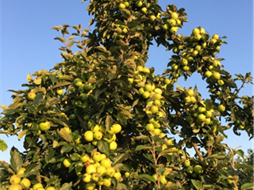 For those considering planting this year, we’re always happy to help. Free consultations can be booked via our website or calling us 01404 812229, whether you’re planning a single tree or a larger scheme. A walk around the nursery in Venn Ottery often provides clarity that plans on paper can’t.
Late winter is not the most dramatic time on a farm, but it may be the most honest. There’s little to hide behind – just soil, trees, weather and time. As spring approaches, Bowhayes Farm is preparing for another growing season, grounded in what’s been learned and hopeful about what’s to come.
Howard Hughes

Recent Comments